The School of Çay: Learning to Loiter in Hisarönü's Cafés
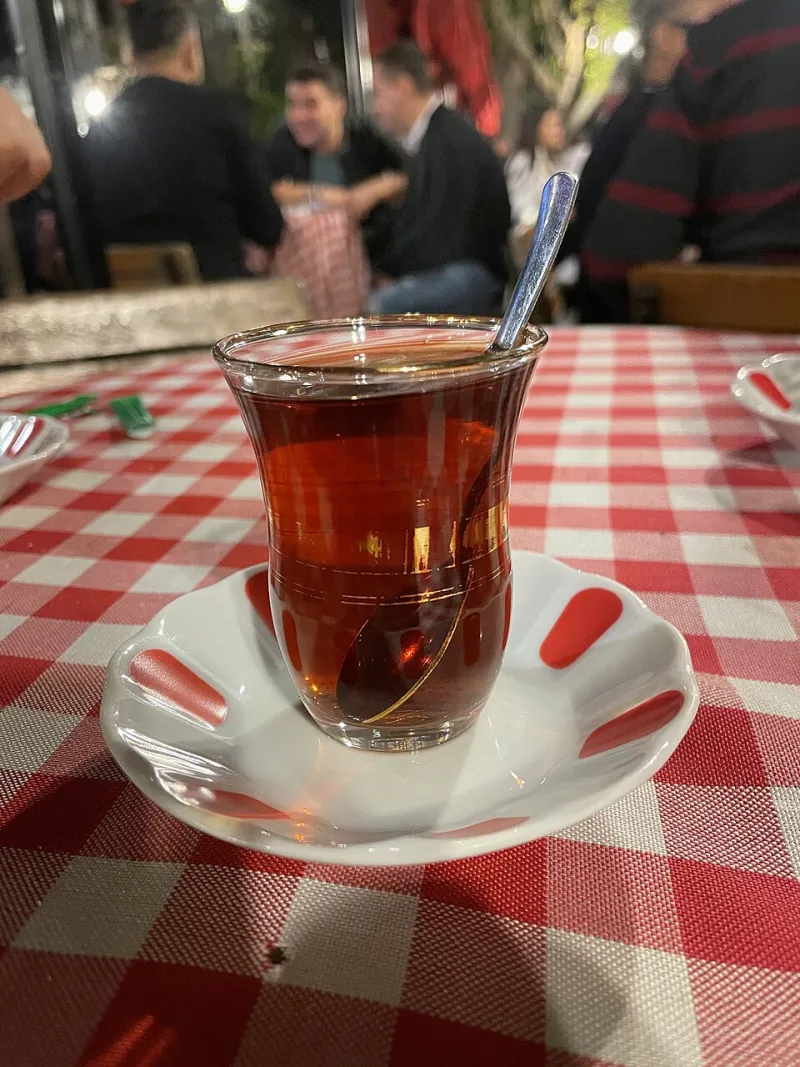
Photo: eXploration Etoile , CC0, via Wikimedia Commons
Every holiday has a pace. Hisarönü's official pace is set by the dolmuş, the sun and the happy hour board outside the bars. But there's another pace, and it lives in the cafés. Not the restaurants with laminated menus and photos of full English breakfasts. The proper cafés: the village tea gardens, the bakery tables, the strip-side terraces where the chairs face out and the tea comes in a glass the size of a thimble.
Learning to sit in them is, I think, the most useful holiday skill nobody teaches you. It's not about finding the best café. It's about learning how to be in one.
First, the tea
Çay — pronounced like 'chai' without the i — is the default social unit of Turkey. It arrives in a tulip-shaped glass, strong and amber, with two sugar cubes on the saucer. You don't need to order food. You don't need to explain yourself. You sit, you say 'bir çay lütfen' (one tea please), and the world slows down.
A few phrases go a long way. 'Şekersiz' means no sugar. 'Açık' means weak — literally 'light'. 'Demli' means strong. If you're not sure, just take it as it comes. The first glass is always too hot, the second is just right, and the third is when you start to understand why nobody's in a hurry.
The etiquette is simple: don't stir for ages, don't dunk everything in sight, and don't ask for milk. If you want a second, catch the waiter's eye and raise your glass slightly. They'll understand. If you don't want a second, leave your spoon on the saucer or your glass half full. Nobody will be offended.
Reading the room
Cafés have rhythms. The morning crowd is older men with newspapers and backgammon boards. The afternoon crowd is a mix of shoppers, students and people who have decided that today is not the day for the beach. The evening crowd depends on where you are — the strip-side terraces fill up with holidaymakers, while the village tea gardens stay stubbornly local.
The mistake first-timers make is treating a café like a restaurant: ordering a full meal, expecting to be served quickly, leaving as soon as the plates are cleared. A café is not a transaction. It's a room you borrow for an hour. The longer you sit, the more you get out of it — and the cheaper it gets per minute.
The three cafés you'll meet
The village tea garden. Usually a courtyard or a patch of shade with plastic chairs and a samovar. Men play cards or tavla, the tea comes fast, and the whole place smells faintly of tobacco and dust. Women are welcome, but read the room. If it's just blokes and a television showing football, maybe save it for another day.
The bakery café. A fırın with a few tables outside. You come for simit, börek or a slice of something sweet, and you stay for the tea. These are the best value cafés in town, and the least pretentious. Point at what you want, pay at the counter, sit down. Nobody will rush you.
The strip-side terrace. Wicker chairs, fairy lights, a menu with pictures. These are the cafés that exist for holidaymakers, and there's no shame in using them. They're good for people-watching, and the tea is usually fine. Just expect to pay two or three times what you'd pay in a village garden. You're paying for the view and the cushions.
Backgammon without the drama
Tavla — backgammon — is the soundtrack of Turkish café life. The rattle of dice, the slap of a piece, the small exclamation when someone rolls a double six. It looks intimidating. It isn't.
The rules are the same as the backgammon you might have played at home, with one or two small differences. But the etiquette matters more than the rules. Don't grab the dice before your opponent has finished their turn. Throw them into the board, not across the table. If you're invited to play, accept — even if you're terrible. Especially if you're terrible.
The first time I played in a village café, I rolled a double six and celebrated like I'd won the Champions League. The whole place looked at me like I'd dropped a kebab. My opponent smiled, raised his eyebrows, and rolled a double five. I lost. It was the best hour of the week.
The lesson: play slowly, lose gracefully, and don't make a spectacle of yourself. You're not there to win. You're there to sit.
Why the cheapest hour is the best hour
A glass of çay costs less than a bottle of water in some places. Two glasses and a game of tavla can fill an afternoon for the price of a round of soft drinks. But the real value isn't the price. It's the permission to do nothing.
Holidays are full of doing. Boat trips, beach days, excursions, the pressure to have the best time. A café gives you permission to stop. You can watch the street. You can listen to the dice. You can have a conversation that goes nowhere. You can be a person on a chair, in the shade, with a small glass of tea, and that is enough.
That's the education. Not the best café, or the strongest tea, or the most authentic experience. Just the ability to sit still in a place that isn't yours, and let it be yours for an hour. The Hisarönü strip will still be there when you leave. It always is.